
Professional Guide to Backlash Tolerances & Bearing Preload in Tractor Hypoid Sets
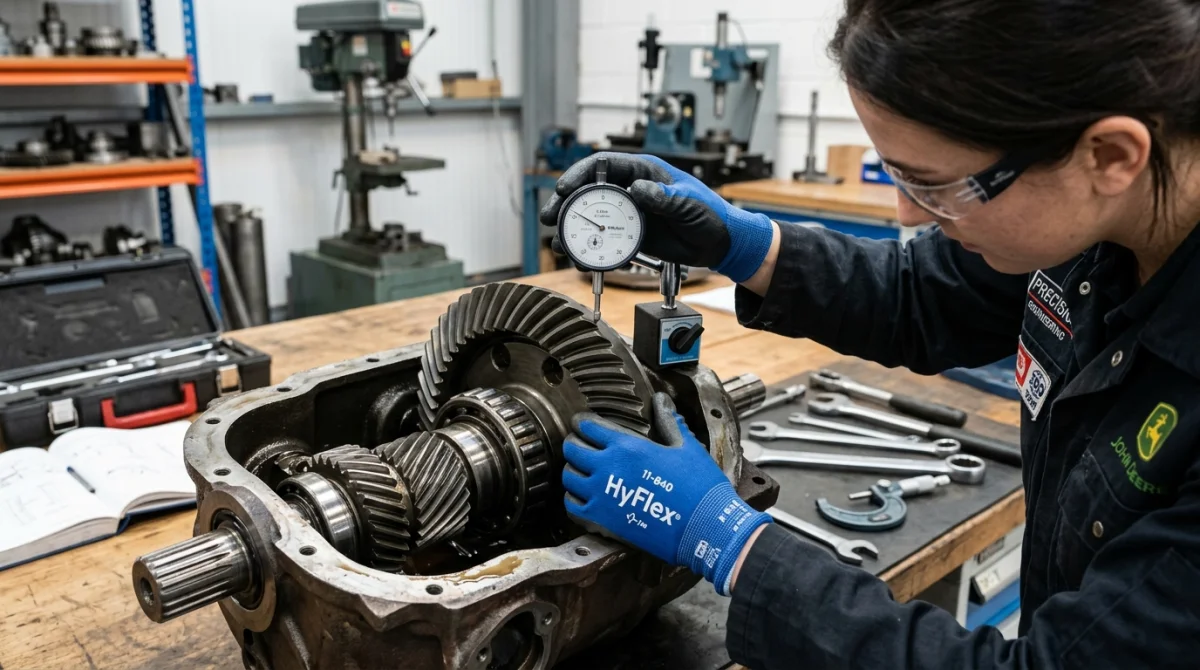
The Physics of Backlash in Hypoid Bevel Drives
Backlash represents the clearance between non-driving tooth surfaces of the mating pinion and crown wheel gears. This clearance accommodates thermal gear expansion and permits the continuous hydrodynamic lubricant film to form.
- Insufficient Backlash (< 0.12 mm): Causes localized overheating, oil film shear breakdown, metal-to-metal scuffing, and bearing seizure.
- Excessive Backlash (> 0.28 mm): Generates harsh driveline clunk on direction changes, excessive backlash slop, and tooth edge spalling.
Dial Indicator Measurement Protocol
1. Mount a magnetic base dial indicator securely onto the carrier housing, orienting the probe stylus perpendicular to the crown wheel tooth flank profile.
2. Lock the input pinion shaft stationary and rock the crown gear back and forth. The indicated sweep must read between 0.15–0.22 mm.
3. Adjust carrier bearing shims to shift the ring gear laterally until exact backlash targets are achieved.
Tooth Contact Pattern Verification
Coating 3–4 ring gear teeth with Prussian blue marking compound under simulated rotational drag confirms tooth contact shape. An ideal contact pattern is elliptical, positioned centrally slightly biased toward the toe side.