
The Critical Role of Induction Hardening & Carburizing in Heavy Gearbox Shaft Longevity
Introduction & Mechanical Challenges of Power Transmission Shafts
In heavy agricultural machinery drivetrain systems, transmission spline shafts and axle shafts continuously endure cyclic torsional stresses and severe shock loads triggered by abrupt clutch engagement or heavy soil compaction. A homogeneously hard shaft risks catastrophic brittle fracture, while an overly ductile shaft suffers tooth deformation and rapid spline wear.
Principles of Surface Engineering: Induction Hardening vs. Carburizing
To achieve peak operational life, metallurgical engineering combines two distinct properties: a super-hard wear-resistant outer case and a tough, ductile inner core capable of absorbing mechanical shock energy.
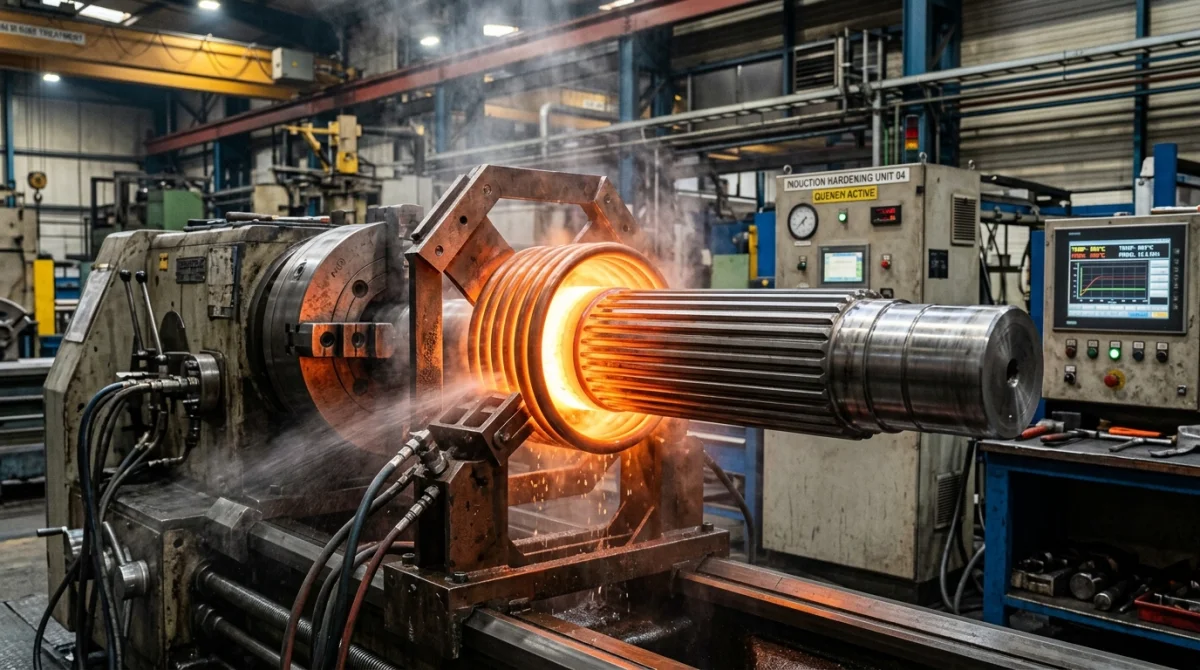
- Induction Hardening: High-frequency electromagnetic inductors rapidly heat the steel surface layer to austenitizing temperatures (850–900°C) within seconds, followed by immediate polymer quench to synthesize a fine martensitic microstructure.
- Atmospheric Carburizing: Diffusing carbon atoms into low-carbon alloy steel cases to achieve surface hardness between
58–62 HRCwith a controlled Effective Case Depth (ECD) of 1.2–1.6 mm.
Metallurgical Control at PSNT Manufacturing Facilities
At Pishtaz Sanat Novin Tabriz, automated CNC induction scanners continuously regulate coil power, transit speed, and quench flow to guarantee adherence to strict DIN ISO 15787 metallurgical standards.
Conclusion & Maintenance Takeaways
Deploying shafts manufactured with certified surface hardening profiles extends gearbox operational lifespan by more than 400%, preventing catastrophic in-season tractor downtime.